
The workforce is supported by a network of systems that are designed to help people learn, grow, and find opportunity. Education systems, workforce programs, employer systems, and hiring platforms all play a role. Each of them captures information about people. Each of them observes performance, progress, and potential in different ways.
In theory, these systems should be producing rich, actionable signals about what people can do.
In practice, they rarely are.
The issue is not that these systems lack data. It’s that they struggle to translate what they observe into signals that can be clearly understood, trusted, and used outside of their immediate context. Information is collected, stored, and reported, but it often stops there. It remains locked within the system that created it, disconnected from the broader ecosystem where it could create value.
This pattern shows up across the workforce. But it is especially visible in education.
Education systems are designed to determine whether students are learning. Subjects are taught, students are assessed, and performance is captured through grades, transcripts, and credentials. These are signals, but they are narrow ones. They reflect how a student performed within a specific structure, at a specific moment in time.
What they do not consistently capture is how a student shows up.
They do not clearly signal who is reliable, who is motivated, who adapts when something is difficult, or who takes initiative when given the opportunity. They do not reflect who contributes to a team, who leads, or who recognizes problems and works to solve them. They do not translate learning into the applied skills that employers are ultimately trying to understand.
And yet, these signals are present.
They are visible every day within the system itself. In who shows up to class consistently. In who goes beyond the minimum requirements. In who seeks feedback, collaborates with others, or finds ways to improve the environment around them. In the skills students develop as they navigate challenges, work with others, and take ownership of their progress.
The system sees these things. It just does not consistently capture or communicate them.
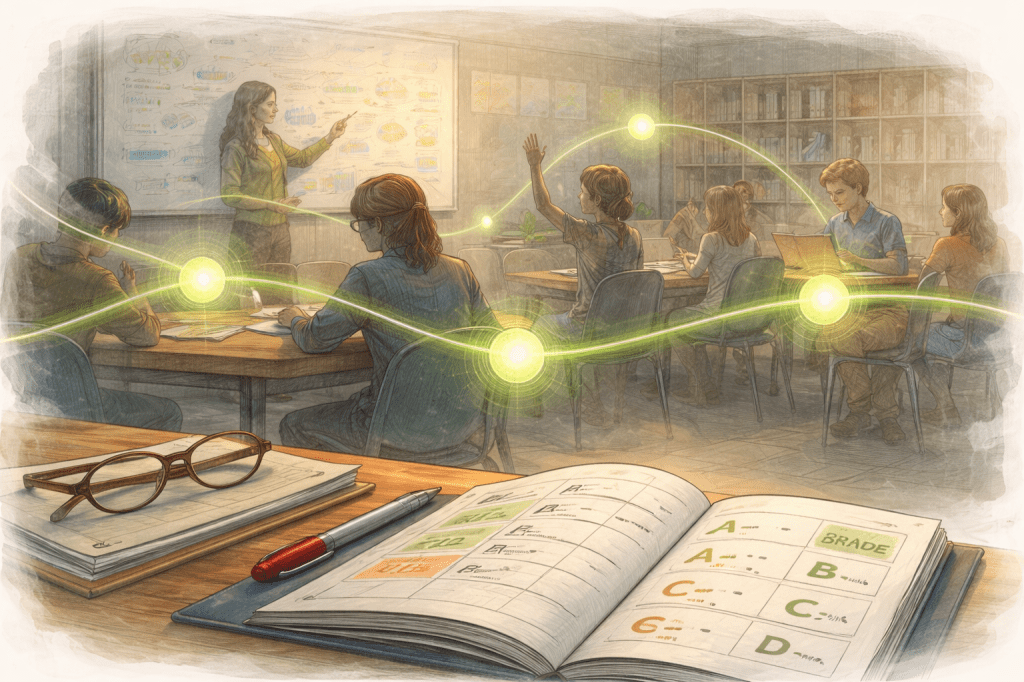
As a result, when students leave education and enter the workforce, much of what makes them capable remains invisible. They are represented by a narrow set of signals that do not fully reflect their potential. Employers are left to interpret incomplete information. Individuals are left to explain themselves through formats that were never designed to capture the full picture.
This is not a failure of education alone. It is a pattern that exists across the workforce ecosystem. Systems are doing the work they were designed to do. But they are not yet producing the signals that the broader system needs.
The opportunity is not to replace these systems. It is to help them do more with what they already see.
Because when systems begin to produce clearer, more complete signals, something important changes. Information becomes more than a record of the past. It becomes a way to understand what someone can do, how they operate, and where they can contribute.
That is when the system starts to move from storing information to creating value.

 Signol Labs
Leave a comment