
The workforce is not lacking in information. Systems across education, workforce development, and employment generate data about people every day. They observe progress, track performance, and capture outcomes. In many cases, they even produce signals that begin to describe what someone knows or can do.
But most of those signals never reach their full value.
They remain tied to the system that created them. They are difficult to verify outside of their original context. They are not easily shared, combined, or interpreted across systems. As a result, they are rarely used in the moments that matter most, when decisions are made about hiring, advancement, or opportunity.
Signals do not create value when they are created.
They create value when they can be used.
That is where activation comes in.
Activation is what allows a signal to move beyond its point of origin. It is what makes it possible for information about a person to be understood in different contexts, by different systems, and by different decision-makers. It is what turns a record into something that can be trusted, interpreted, and acted upon.
For a signal to be activated, it needs a few things to be true. It needs to be structured in a way that others can understand. It needs to be portable so it can move with the individual. It needs to be verifiable so it can be trusted without re-interpretation. And it needs to be visible at the right moment, when a decision is being made.
These are not small requirements. But they are increasingly achievable.
One of the clearest examples of this shift is the emergence of Learning and Employment Records.
LERs are designed to capture a more complete picture of an individual’s experiences, achievements, and capabilities. They move beyond narrow representations like transcripts or resumes and begin to describe learning and work in ways that are more structured, more detailed, and more connected to real-world application.
More importantly, they are designed to move.
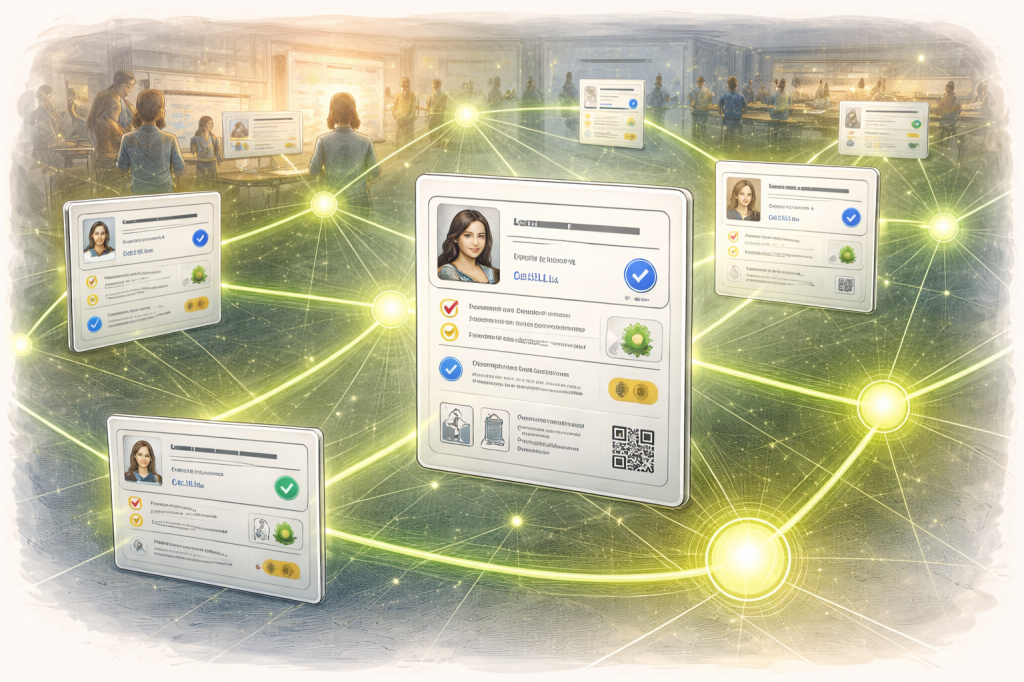
When implemented effectively, LERs allow signals created in one system to be carried into another. A learning experience can become visible in a hiring context. A credential can be verified without relying on manual interpretation. Skills and experiences can be understood not just as isolated events, but as part of a broader, evolving profile.
This is what activation looks like in practice.
It does not require replacing existing systems. It builds on them. It takes what systems already observe and makes it more usable. It creates a layer where signals can be shared, trusted, and combined in ways that were not previously possible.
LERs are an important step in this direction. But they are not the only path.
Activation can take many forms. It can emerge through standards, through infrastructure, through better data models, and through new ways of connecting systems that were previously isolated. What matters is not the specific mechanism, but whether the result is the same. Signals that can move. Signals that can be trusted. Signals that can be used.
When that happens, something begins to change.
Signals that were once fragmented start to come together. Individuals become easier to understand. Employers are able to make more informed decisions. Systems begin to operate with greater alignment.
And over time, a layer of skills intelligence begins to emerge.
Not as a product, but as a capability of the ecosystem itself.
That is the shift underway. And it is what makes it possible for the workforce to function more like a true market, where information flows, trust is built into the system, and opportunity can move more freely.

 Signol Labs
Leave a comment