
The recent whitepaper From Silos to Systems: Building the Skills Ecosystem America Needs by UpSkill America at the Aspen Institute and Alvarez & Marsal is one of the clearest articulations yet of the real infrastructure challenges facing the workforce data ecosystem.
The paper does not frame the problem as a shortage of credentials, wallets, marketplaces, or workforce platforms. Instead, it identifies something much deeper: the systems themselves still do not work together.
Workers repeatedly re-enter the same information. Credentials do not move cleanly between platforms. Employer systems are not designed to consume skills data. State talent marketplace initiatives risk becoming isolated repositories of records rather than connected infrastructure for mobility and opportunity. The paper correctly identifies that the challenge is not simply producing more data. It is building the connective infrastructure that allows data to move meaningfully across education, workforce, hiring, and state systems.
For several years, much of the Learning and Employment Record ecosystem has focused primarily on issuing verifiable credentials and standing up digital wallets to hold them. Those efforts are important, and the progress made across the ecosystem deserves real recognition. But Upskill America and Alvarez & Marsal paper gets to the heart of a growing realization across the market: portability alone is not enough if what moves between systems is incomplete, difficult to operationalize, or disconnected from actual hiring workflows.
One of the most important observations in the paper is also one of the simplest: employers still hire through resumes and applicant tracking systems. The report notes directly that employer systems are “currently configured for resumes rather than skills data” and that “the PDF resume is still ubiquitous.” That is not a minor implementation detail. It is one of the defining realities of the modern labor market.
Too often, the ecosystem has implicitly framed the future as “resumes versus credentials,” as though employers will eventually abandon existing hiring workflows entirely and replace them with something wholly new. In practice, that has never been a realistic adoption path. Hiring infrastructure evolves incrementally. Employers adopt systems that reduce friction, integrate into existing workflows, and improve decision-making without requiring wholesale operational reinvention.
This is where the Trusted Career Profile (TCP) becomes increasingly important to the interoperability conversation.
Not because TCP replaces credentials, wallets, Learning and Employment Records, or talent marketplaces. And not because TCP is a cure-all for the ecosystem’s coordination and governance challenges. It is not.
But TCP addresses a critical infrastructure gap that the report implicitly surfaces throughout: the need for a portable, interoperable representation of the total profile of an individual’s capabilities and experiences. That distinction is critical.
Real hiring decisions are not based solely on formally verified credentials. They involve a much broader picture of human capability: work history, inferred skills, portfolios, military experience, self-attested experiences, projects, career progression, references, demonstrated competencies, and contextual narrative alongside verifiable records. The workforce ecosystem increasingly understands the importance of verified data, particularly in a world shaped by AI-generated resumes and synthetic candidate materials. But a labor market built only around formally verified artifacts would still fail to capture much of what employers actually evaluate when making decisions.
The paper repeatedly points toward this tension. It discusses the absence of “holistic” learner records, the lack of portable representations of workplace learning, and the fragmentation that occurs when individuals move between systems and must continually reconstruct their professional identity from scratch. It warns that many current systems still depend on the learner manually transporting data between platforms and acknowledges that many important forms of learning and capability development remain undocumented or disconnected from interoperable infrastructure.
This is precisely why interoperability cannot simply mean “credential portability.”
Interoperability must also mean profile portability.
The ability for individuals to move rich, structured, machine-readable career data between systems without losing context, meaning, or usability may ultimately become one of the defining infrastructure requirements of the next generation workforce ecosystem. That is the role TCP is uniquely positioned to help operationalize.
At its best, TCP does not compete with the ecosystem emerging around verifiable credentials and Learning and Employment Records. It harmonizes it.
Verifiable credentials can feed into TCP. Wallets can carry TCP-compatible data. Talent marketplaces can exchange TCP profiles. HR systems can consume TCP-structured career information while still supporting familiar resume workflows. AI systems can reason over richer career representations with greater context and transparency. State workforce systems can create more continuity between education records, hiring systems, workforce development initiatives, and labor market intelligence platforms.
In that sense, TCP is less a competing standard than an interoperability layer capable of connecting many of the ecosystem components already being built.
This matters particularly for state talent marketplace initiatives now emerging across the country.
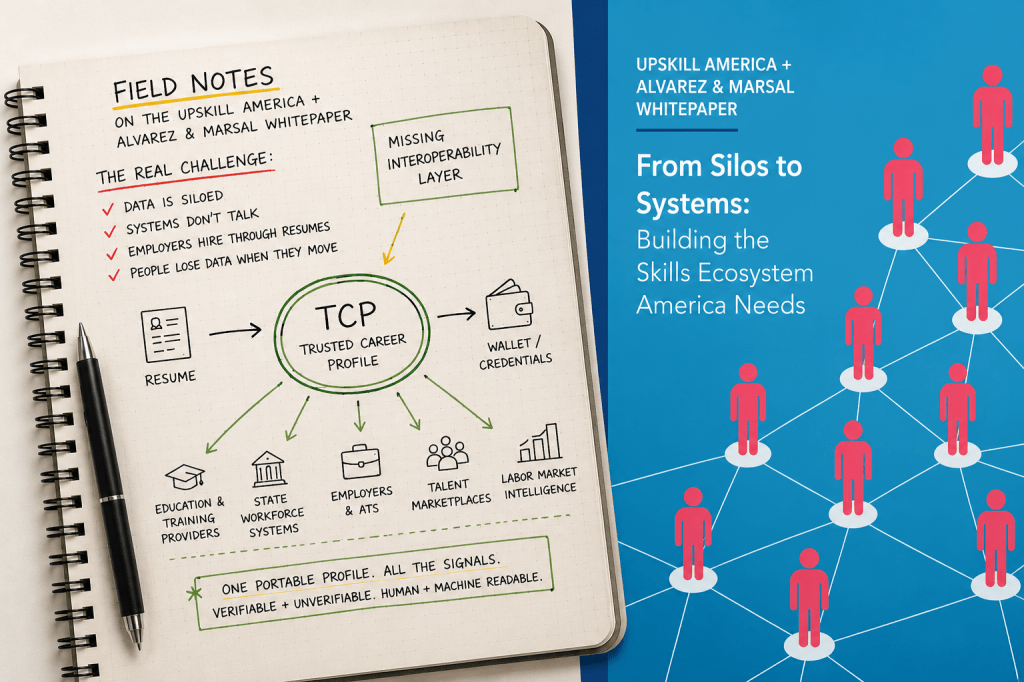
UpSkill America and Alvarez & Marsal paper correctly highlights that states are rapidly becoming central organizing units for workforce interoperability infrastructure. Through initiatives like the Connecting Talent to Opportunity Challenge and related state workforce modernization efforts, states are beginning to make major procurement and architecture decisions that may shape the labor market ecosystem for years to come.
Those decisions carry enormous long-term consequences.
If state talent marketplaces are built primarily as repositories of credentials without robust mechanisms for profile portability and interoperability across hiring systems, workforce systems, education systems, and external marketplaces, there is a real risk of recreating the very silos the ecosystem is attempting to solve. The challenge is not merely helping individuals store credentials. It is enabling people to carry usable, intelligible, actionable professional identities across systems and opportunities over time. That requires infrastructure capable of supporting both verifiable and unverifiable data together as part of a broader, portable career profile.
Importantly, none of this diminishes the tremendous value of the work being done across the ecosystem today. The Aspen Institute, UpSkill America, Alvarez & Marsal, standards bodies, wallet providers, credentialing organizations, state leaders, education systems, and workforce innovators are collectively helping move the market toward a more interoperable future. The paper itself is an important contribution because it shifts the conversation away from isolated tools and toward systems-level thinking.
But systems-level thinking also requires confronting an uncomfortable reality: interoperability is not solved simply because credentials become digitally portable.
The workforce ecosystem still needs a shared profile layer capable of operationalizing and harmonizing how human capability is represented across fragmented systems.
That may ultimately become one of the most important infrastructure conversations in the entire ecosystem.

 Signol Labs
Leave a comment