
One of the reasons I started Signal Mapping is that I have become increasingly convinced that some of the most important developments in workforce technology are visible long before they become obvious. They often show up first in conversations, working groups, and convenings where people from different parts of the ecosystem are trying to solve a shared problem. If you pay attention to who is in the room, what questions are being asked, and where there is agreement or disagreement, you can often see where the market is headed before the rest of the industry notices.
Earlier this year, I had the opportunity to participate in one of those conversations.
Ahead of the Digital Credential Summit in Philadelphia, 1EdTech convened a working session focused on interoperability across the Learning and Employment Record (LER) ecosystem. It was an interesting room. Representatives from some of the largest credential issuing platforms were there alongside organizations building learner-facing wallets, institutions experimenting with new approaches to learner records, workforce organizations focused on connecting people to employment, and early consumption-layer innovators such as SmartResume and WGU’s Achievement Wallet initiative. There were standards experts, implementers, and practitioners who spend their days trying to make these systems work in the real world. On the surface, the conversation was about credential transport and interoperability. In practice, it became a discussion about something much bigger.
The 1EdTech report that emerged from that effort focuses on how digital credentials move between systems. It examines the mechanisms available today, identifies remaining gaps, and concludes that the most significant unresolved challenge is large-scale synchronization between platforms. In other words, while the ecosystem has made meaningful progress helping individuals move credentials from one place to another, there is still work to be done when organizations need systems to exchange and maintain data over time. That is an important finding, and I largely agree with it. But I left the conversation thinking about a different question altogether.
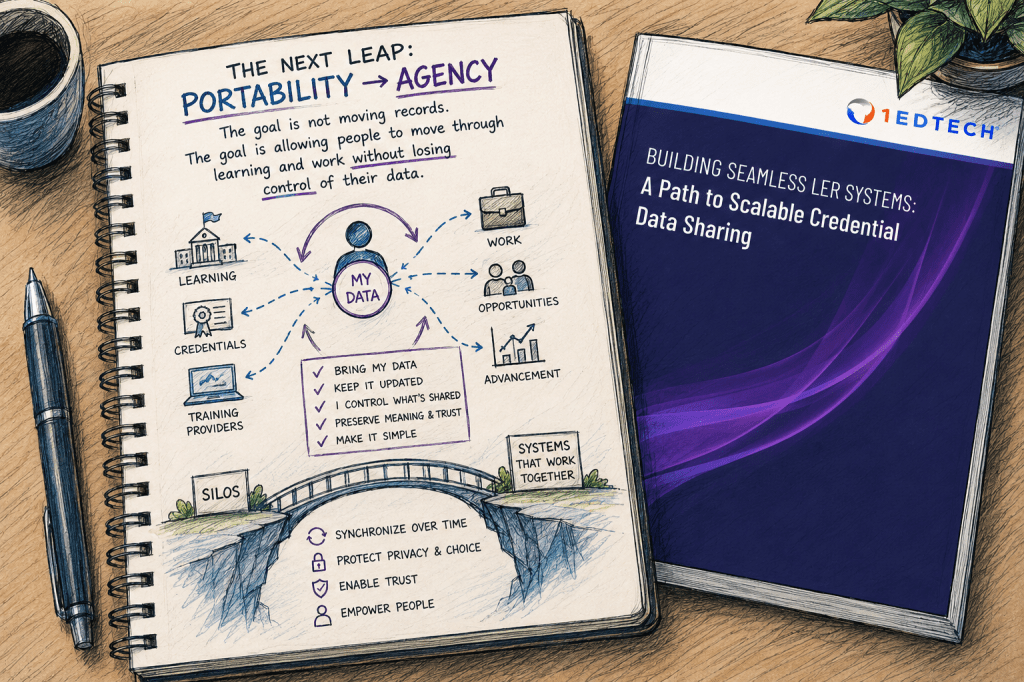
The goal is not moving records.
The goal is allowing people to move through learning and work without losing control of their data.
That distinction may sound subtle, but I think it fundamentally changes how we should think about the next phase of this ecosystem.
Much of the conversation around interoperability starts with the technology itself. Can a credential move from an issuer to a wallet? Can it be shared with an employer? Can it be verified? Can different platforms exchange information without custom development work? These are all worthwhile questions, and the ecosystem has made substantial progress answering them. However, they are still infrastructure questions. They are not the questions that learners, workers, or employers wake up thinking about every day.
What people actually want is much simpler.
They want their information to follow them.
If they change platforms, they want their data to come with them. If they earn new credentials, they want those records to appear automatically wherever they manage their professional identity. If they are exploring opportunities, they want to decide what information becomes visible and what remains private. Most importantly, they want all of this to happen without needing to understand wallets, verifiable credentials, synchronization protocols, or interoperability standards.
During the discussion, I found myself returning to a scenario that feels increasingly common. Imagine a learner who has accumulated credentials, experiences, and achievements across multiple systems. They decide they want to manage their professional identity through a new platform. Their expectation is straightforward: move all of my existing information from Platform A to Platform B, continue moving any new information that is created in the future, and give me control over when and how that information is used. Perhaps they want their records synchronized behind the scenes but do not want every credential immediately displayed on a public-facing profile. Perhaps they want certain achievements visible to employers while keeping others private. Perhaps they simply want confidence that their information will remain available to them regardless of which platforms succeed or fail over time.
From a user perspective, that sounds completely reasonable.
From a technical perspective, it is surprisingly difficult.
The existing standards ecosystem contains mechanisms that can move individual credentials between systems. What it does not yet fully provide is a comprehensive framework for creating seamless, user-controlled experiences across multiple platforms over time. As a result, many of the most effective implementations today rely on proprietary APIs, custom synchronization layers, and platform-specific integrations. This is not necessarily because organizations are trying to avoid standards. It is because they are trying to solve real user problems that the standards do not yet completely address.
This is why I increasingly believe the next challenge facing the ecosystem is not portability. It is agency.
Portability asks whether data can move.
Agency asks whether people remain in control as it moves.
Those are related questions, but they are not the same thing.
At the same time, another realization is beginning to emerge. Even if we solved every portability challenge tomorrow, we would still face a much larger problem. Data that moves successfully is not necessarily data that creates opportunity.
A credential can move from an institution to a credential platform. It can move from that platform into a wallet. It can move from a wallet into a talent marketplace. It can even make its way into an applicant tracking system. Yet none of those transfers guarantee that an employer will understand it, trust it, or use it in a meaningful decision. The report itself acknowledges this reality, noting that employer readiness remains one of the largest barriers to adoption. That observation is incredibly important because it suggests that the industry’s challenge is no longer simply about creating standards for information exchange. Increasingly, it is about ensuring that the systems consuming the information can actually put it to work.
That is why I left Philadelphia thinking less about APIs and more about infrastructure.
The first phase of this movement was creating digital credentials. The second phase has focused on making those credentials portable. The next phase will be about making them useful. That means creating systems that preserve meaning, support trust, fit into existing workflows, and empower individuals to benefit from their own information without becoming experts in the technology that makes it possible.
The conversation in that room may have been framed as an interoperability discussion. What I heard was something else. I heard an ecosystem beginning to recognize that the future is not simply about moving records between systems. It is about creating the conditions that allow people to move through learning and work without losing ownership of their story.
That feels like a much bigger opportunity—and a much more important signal.

 Signol Labs
Leave a comment