
Over the last few days, I’ve received more than a dozen messages asking the same question:
“What do you think about the California Career Passport winners?”
My initial reaction was to evaluate the vendors themselves. After all, California recently announced four organizations that will move forward in the Career Passport pilot process: Certree, Infosys, SpruceID, and Territorium. Each brings a very different set of strengths to the table, and it’s natural to wonder which approach the state ultimately prefers.
But after reading California’s recently released planning report and spending time with both the winners and the broader strategy behind the initiative, I’ve come to believe that the more interesting question is not who won.
It’s what California appears to be learning.
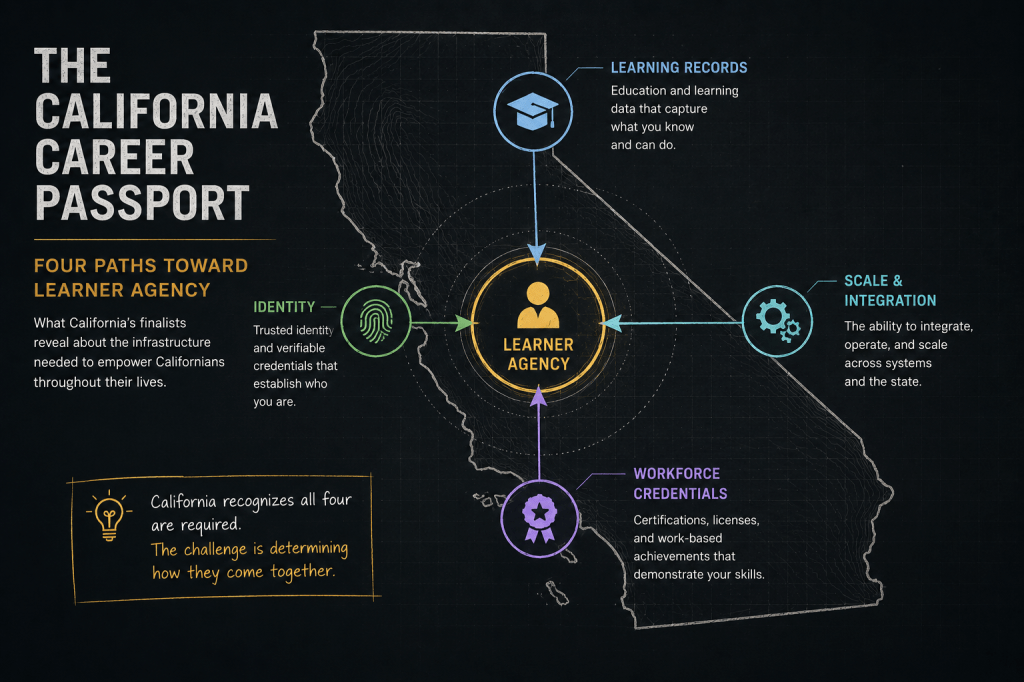
At first glance, the finalist list feels unusual. SpruceID brings expertise in identity, privacy, and verifiable credentials. They built California’s mobile driver’s license wallet and have become one of the most visible players in decentralized identity infrastructure. Territorium comes from the learning and employment record world, with deep roots in higher education, competency frameworks, Open Badges, and the Comprehensive Learner Record. Certree has focused on professional certifications, workforce credentials, and trusted digital records that extend beyond traditional academic environments. Infosys brings something entirely different: the ability to integrate, operate, and scale large systems.
What fascinates me is that each finalist appears to represent a different piece of the puzzle. Identity. Learning. Workforce credentials. Scale.
And that leaves me both encouraged and confused.
I’m encouraged because California clearly recognizes that building a statewide Career Passport requires all of these capabilities. Too often, workforce technology conversations reduce complex ecosystem challenges to a single product category. The finalist list suggests California understands that learner agency ultimately requires trusted identity, educational records, workforce credentials, interoperability, and the ability to operate at statewide scale.
At the same time, California can only select one path forward. The four finalists seem to have been chosen precisely because they excel in different areas. That suggests California isn’t simply evaluating wallet products. They’re evaluating the capabilities required to support learner agency across an entire ecosystem. The challenge, of course, is that those capabilities are currently distributed across multiple providers, which makes the final selection particularly interesting to watch.
The planning report reinforces this interpretation. Throughout the document, California highlights lessons learned from Alabama, Arkansas, WGU, ASU, Colorado, Montana, and other organizations working on similar initiatives. The recurring themes aren’t really about wallets at all. They are interoperability, governance, learner agency, employer engagement, credential registries, and long-term sustainability.
In other words, California appears to understand that this is an ecosystem challenge, not a wallet challenge.
One thing I particularly appreciate is that the state published its thinking. Too often, procurement announcements arrive with little explanation, leaving observers to speculate about the motivations behind a decision. In this case, California provided a detailed planning report that offers a rare look into the research, conversations, and implementation lessons that informed the process. Whether you agree with every conclusion or not, the transparency is refreshing.
Several themes stood out to me as I worked through the report.
The first is that governance matters as much as technology. The most successful projects weren’t simply deploying software. They were building coalitions, securing policy support, aligning institutions, and creating sustainable operating models. Technology was necessary, but it was never sufficient.
The second is that interoperability is non-negotiable. Nearly every successful implementation relied on multiple systems, multiple vendors, and open standards. None of the projects studied appeared to believe a single platform could solve the entire challenge. Instead, they focused on enabling data to move across systems and allowing participants to retain flexibility as the ecosystem evolved.
The third is that employer adoption remains difficult. Nearly every initiative found that learners and institutions adopt these tools faster than employers. That’s not a criticism of employers. It’s simply a reflection of how difficult it is to change hiring practices, integrate new data sources into HR systems, and create confidence in unfamiliar technologies.
What struck me most, however, was the importance of sequencing.
Many of the projects California studied began by creating value for learners before expanding into employer-facing experiences. They focused first on helping individuals collect, control, and use their records. Only after those foundations were established did they begin exploring broader employer adoption strategies.
That lesson may be the most important one in the entire report because I don’t think California is solving for employer adoption yet.
I think California is solving for agency.
The Career Passport appears designed to help Californians collect, control, curate, and share information throughout their lives. Credentials. Skills. Certifications. Learning records. Identity data. The wallet itself is important, but only because it provides the mechanism through which people can exercise control over that information. The real value emerges when individuals can move their data between systems, decide who can access it, and use it to pursue opportunities throughout their lives.
Viewed through that lens, the organizations that didn’t advance may be just as interesting as the organizations that did.
Many of the companies most commonly associated with issuing digital credentials are absent from the finalist list. Historically, these platforms have focused on helping institutions create and distribute credentials. California appears to be focused on a different question: what happens after issuance? How do records move between systems? How do they connect to identity? How do learners aggregate information from multiple sources? How do they maintain long-term control?
I suspect that’s an important signal to the credentialing market.
Issuing credentials is no longer enough. The next phase of the ecosystem will require thinking more deeply about portability, interoperability, aggregation, and learner control. The value is shifting from creating records to helping people use them.
There are other notable patterns as well. Several solutions that combine records with career services, talent marketplace functionality, labor market tools, or broader opportunity navigation capabilities are also absent from the finalist list. If that’s the correct interpretation, California appears to be prioritizing the creation of a trusted and portable system of record before prioritizing career navigation, talent marketplace functionality, or employer-facing services.
That doesn’t mean those capabilities aren’t important. In fact, I suspect they will become critically important. It may simply mean California believes they belong in a later phase of the journey.
And that’s where my attention goes next.
The sequencing emerging from California tells an interesting story. Today, the state is building the foundation. A Career Passport. eTranscript California. A statewide identity ecosystem that already includes the mobile driver’s license. Interoperable credential infrastructure. These are not isolated projects. They increasingly look like components of a larger architecture designed to give residents greater control over their information.
The first users may be the roughly two million California Community College learners. From there, the audience could expand to California’s broader learner population, approaching seven million individuals across education systems. Ultimately, however, the logical endpoint is much larger.
Thirty-nine million Californians.
At that scale, the Career Passport stops looking like a wallet project and starts looking like public infrastructure.
And once that infrastructure exists, entirely new questions emerge. How do people discover opportunities? How do they navigate career pathways? How do they connect education, workforce, and public services? How do employers engage? How do talent marketplaces leverage trusted data? How do public and private systems create value on top of a trusted foundation of learner-controlled information?
Those questions feel like future phases rather than current objectives.
If that’s correct, California may be following a deliberate sequence. First, create a trusted system of record. Then create agency. Then create value.
For years, much of the conversation around digital credentials has focused on how to issue records. California’s Career Passport initiative suggests the conversation may be evolving. The next challenge is not simply issuing data. It’s helping people own it.
And if California succeeds, the wallet may ultimately prove to be the least interesting part of the story.

 Signol Labs
Leave a comment