
Why Workforce Infrastructure Must Start with the Individual
The systems we rely on to understand, describe, and signal human capability were not designed for the conditions they now face.
For much of the last century, this wasn’t a significant problem. Education was relatively linear. People attended school, entered the workforce, and spent much of their careers building experience within a small number of organizations. Degrees, resumes, job titles, and employer brands functioned as workable proxies for capability because careers themselves were relatively stable. Records moved infrequently because people did too.
Today, learning is continuous. Individuals develop knowledge and skills through colleges, universities, short-term training providers, employers, online platforms, professional associations, volunteer experiences, military service, and countless forms of informal learning. Careers have become increasingly dynamic, requiring individuals to repeatedly move between learning and work throughout their lives.
Yet the systems used to represent people have changed remarkably little.
Most individuals still navigate the labor market using a collection of disconnected artifacts. A resume describes some experiences. A LinkedIn profile describes others. Educational institutions maintain transcripts. Credential providers maintain digital records. Employers maintain employment histories. Licensing bodies maintain certifications. Workforce systems maintain program records.
No single system contains the complete picture.
As a result, individuals spend their lives reconstructing representations of themselves from fragments.
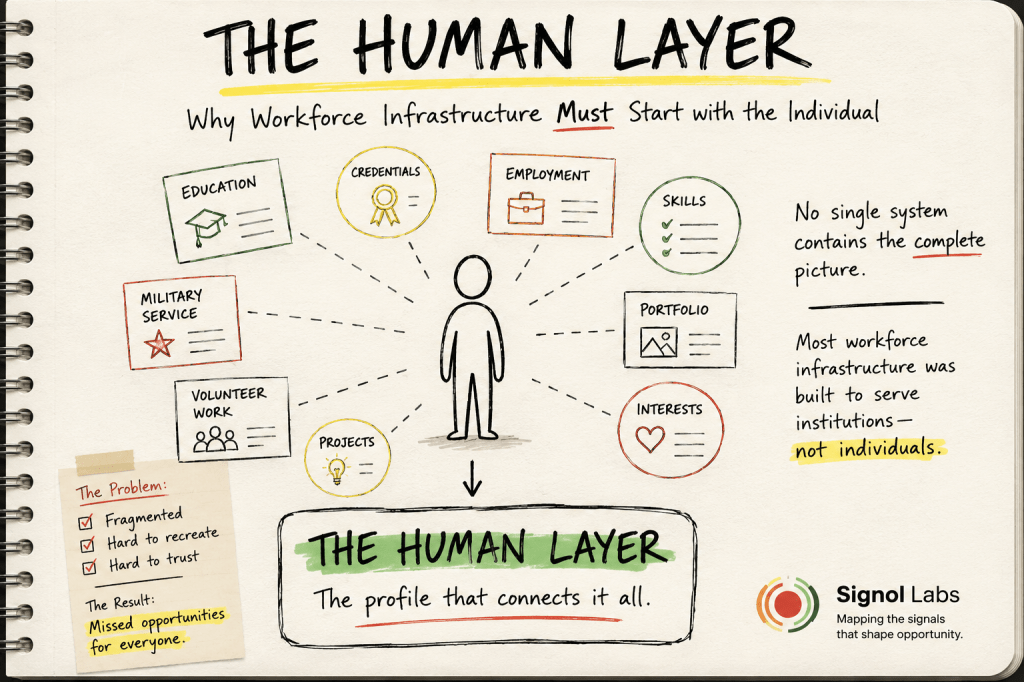
This creates the first challenge. Most people struggle to understand the full extent of their own capabilities.
Ask someone where they went to school and they can usually answer quickly. Ask them where they worked and they can recite a career history. Ask them what they are capable of doing, what evidence supports those capabilities, or how experiences from different parts of their lives connect to one another, and the answers become much harder.
The labor market increasingly rewards individuals who can articulate their capabilities. Yet most people have never been given the tools to inventory, organize, or understand the evidence that describes them.
The challenge is not simply documenting experiences. It is recognizing what those experiences represent. A volunteer coordinator may not recognize they have developed project management skills. A veteran may struggle to translate military experience into language understood by civilian employers. A student may overlook the capabilities developed through coursework, clubs, or part-time work. Much of what people know and can do remains invisible because they lack the tools, language, and frameworks necessary to connect experiences to capability. Before individuals can communicate their capabilities to others, they must first understand them themselves.
The second challenge is fragmentation.
The information that helps describe a person exists across dozens of systems. Educational records live in one place. Employment records live in another. Credentials live somewhere else. Professional accomplishments, projects, portfolios, volunteer experiences, military service, and personal interests often live nowhere at all. Some of the most important information exists only in the memories of individuals who have never been asked to document it or who do not yet recognize its value.
The workforce ecosystem has become increasingly effective at managing pieces of people without ever managing the whole person.
Underneath this fragmentation is a deeper issue. Ownership of the individual’s story is distributed across institutions. Educational institutions own transcripts. Employers own employment records. Licensing bodies own certifications. Workforce systems maintain program records. Individuals maintain resumes and professional profiles. Each system manages a portion of the story, but no system is responsible for helping individuals assemble the complete picture. As a result, people are left to act as the integration layer between systems that were never designed to work together.
A third challenge emerges from this fragmentation.
Because no durable representation of the individual exists, people are repeatedly asked to recreate themselves.
Every application requires another version of the story. Every job board requires another profile. Every workforce system requires another intake process. Every scholarship application, college application, professional network, and talent marketplace asks for slightly different information about the same individual.
The most obvious cost is time. Millions of hours are spent every year entering information that already exists somewhere else. The less obvious cost is information loss.
People do not provide less information because they lack experiences worth sharing. They provide less information because repeatedly documenting those experiences becomes exhausting.
Projects are omitted. Volunteer activities are forgotten. Credentials remain disconnected from the experiences that gave them meaning. Skills go unstated. Accomplishments disappear.
Over time, individuals learn to compress increasingly complex lives into increasingly simplified representations.
The consequences extend beyond the individual. Employers make decisions using incomplete information. Educational institutions struggle to understand outcomes. Workforce systems deliver weaker recommendations. Technology platforms generate less accurate matches.
The absence of a portable representation of the individual reduces the performance of every connected system.
The fourth challenge is trust.
Even when individuals successfully communicate their experiences and capabilities, verification remains difficult. Employers, educational institutions, workforce agencies, and public programs increasingly need confidence that claims are accurate. As AI makes it easier to generate applications, resumes, and supporting materials at scale, the cost of verification continues to rise.
Viewed individually, these challenges appear unrelated. Capability discovery is often treated as a career services problem. Fragmentation is viewed as a data management problem. Repeated self-reconstruction is considered an administrative burden. Trust is approached as a verification problem. In reality, they stem from the same underlying condition. Individuals lack a durable, portable representation of themselves. As a result, they struggle to understand their capabilities, information becomes fragmented across systems, stories must be repeatedly recreated, and trust becomes difficult to establish. What appears to be four separate challenges may ultimately be one.
The workforce ecosystem did not arrive at this condition by accident. Most of the systems that shape learning and work were designed to meet the needs of institutions. Schools needed ways to document academic achievement. Employers needed ways to evaluate applicants. Workforce agencies needed ways to administer programs. Licensing bodies needed ways to verify qualifications. These systems generally perform their intended functions well. The challenge is that they were not designed to help individuals assemble, understand, and maintain a comprehensive representation of themselves over time. As a result, the burden of connecting these systems falls largely on the individual.
This is where much of the current work around digital credentials, verifiable credentials, and Learning and Employment Records becomes important. These efforts address a real problem. They create more portable and trustworthy ways to represent learning and employment outcomes. They improve verification. They improve portability. They improve reuse. But they do not fully solve the individual’s problem.
A learner employment record can verify part of a person’s story. It does not necessarily help them assemble the entire story.
And this may be where the workforce ecosystem has an opportunity to evolve.
Much of the current conversation has focused on creating portable records and then building systems capable of consuming those records. The underlying assumption is that if enough credentials, learner records, and verifiable data exist, value will naturally emerge.
There is another way to think about the problem. What if we begin with the individual instead?
What if every person had access to a portable, lifelong profile capable of representing the full breadth of their experiences, capabilities, aspirations, and evidence? A place where self-asserted information, resumes, portfolios, work history, volunteer experiences, credentials, learner records, and future forms of evidence could coexist. A profile that helps individuals understand themselves before helping systems understand them. That distinction is important. Most workforce systems are designed to help institutions evaluate people. Far fewer are designed to help people understand themselves.
In this model, credentials do not disappear. Learner Employment Records do not disappear. Verifiable credentials become even more valuable. Their role simply changes. Instead of serving as the foundation of the ecosystem, they become trusted sources that enrich a profile capable of serving everyone.
This distinction matters. A credential-first strategy can only serve people who possess credentials. A learner-record-first strategy can only serve people who possess learner records.
A profile-first strategy can serve every individual immediately while creating a natural place for credentials, learner records, and other trusted data sources to accumulate over time.
The difference may seem subtle, but it fundamentally changes how the ecosystem grows. Much of the workforce ecosystem has approached the problem from the record outward. Credentials are issued. Learner records are assembled. Talent marketplaces are built to consume them. The assumption is that value emerges once enough structured data exists. A profile-first approach reverses that sequence. It begins by creating value for the individual and then allows credentials, learner records, employment records, and other trusted data sources to enrich that experience over time.
This distinction fundamentally changes the adoption challenge. Rather than asking individuals to acquire credentials, learner records, or other forms of structured data before receiving value, a profile-first approach delivers value immediately. Individuals can begin with the information they already possess. Over time, credentials, learner records, employment records, and other trusted sources can enrich the profile as they become available. The profile serves everyone on day one while creating a pathway toward a richer and more verifiable ecosystem over time.
The question is not whether America needs better credentials, better interoperability, better learner records, or better talent marketplaces. It needs all of those things.
The question is whether the workforce ecosystem has spent so much time building infrastructure between systems that it has overlooked the infrastructure individuals need to participate in that ecosystem.
America has occupational infrastructure and credential infrastructure. America is building interoperability infrastructure and talent marketplace infrastructure.
What remains largely absent is personal workforce infrastructure: a persistent, portable, individual-controlled representation of human capability that can move across learning, work, and workforce systems throughout a person’s life.
Until that layer exists, individuals will continue to reconstruct themselves over and over again while the systems around them operate with incomplete representations of human capability.
Such a profile would not replace credentials, learner records, resumes, or talent marketplaces. It would provide a common foundation for all of them. Credentials could flow into it. Learner records could enrich it. Talent marketplaces could consume it. Employers could evaluate it. Individuals could carry it throughout their lives. The profile becomes the persistent asset while the systems around it continue to evolve.
The next chapter of workforce innovation may not begin with a credential, a learner record, or a marketplace. It may begin with a profile.

 Signol Labs
Leave a comment