
In my previous article, I argued that the workforce ecosystem is missing a Human Layer: a portable career profile that gives people a way to carry information about themselves from one system to the next.
But a portable profile doesn’t become valuable simply because it exists. It becomes valuable when the entire workforce ecosystem is built to support it.
That’s what infrastructure makes possible.
As AI transforms work, we’ll increasingly rely on workforce systems to help people navigate career transitions, identify new opportunities, recommend education and training, and connect to jobs. Those systems can only be as effective as the information they have about the people they’re trying to help.
Today, nearly every workforce platform asks people to rebuild their professional identity from scratch. You create a profile on LinkedIn. Then another on Indeed. Another for your state’s workforce system. Another when you apply to a university. Another when you file for unemployment insurance. Another when you apply for a job.
Every one of those systems is trying to answer the same question.
Who is this person, and how can I help them?
The answers they receive are almost always incomplete.
Every system asks many of the same questions in slightly different ways. Every system stores its own copy. Every system gradually learns something valuable about you over time. And almost none of that information follows you.
The result isn’t simply frustrating. It means every workforce platform operates with an incomplete understanding of the people it serves.
We don’t have a profile problem.
Our lives are already full of profiles.
We have a portability problem.
Every platform knows people resist lengthy onboarding. Every additional question reduces the number of people who complete the process. During nearly a decade working in hiring marketplaces, I watched every platform wrestle with the same reality: ask for too much information and users abandon the experience. So every platform settles for the bare minimum.
The result is predictable. Every platform becomes data-starved. Not because richer information wouldn’t be valuable. Because every organization has to convince people to recreate themselves before it can provide value in return.
Every new platform starts over. Every job application starts over. Every career transition starts over. No private company can really solve this problem. In fact, they have little incentive to.
Profiles are one of the ways workforce platforms differentiate themselves. The more they learn about people, the better recommendations they can make, the more personalized their services become, and the harder it is for users to start over somewhere else. That’s not a flaw in the market. It’s exactly how competition works. But it also means no private company has much incentive to make it easy for people to leave with the information they’ve accumulated.
That’s why profile portability—not any individual platform—should become public infrastructure.
Roads don’t compete with trucking companies. GPS doesn’t compete with navigation apps. The internet didn’t compete with websites. Public infrastructure creates a common foundation that allows private innovation to flourish.
The workforce ecosystem needs that same foundation.
People should be able to invest their time creating a rich career profile once and then use it anywhere they choose.
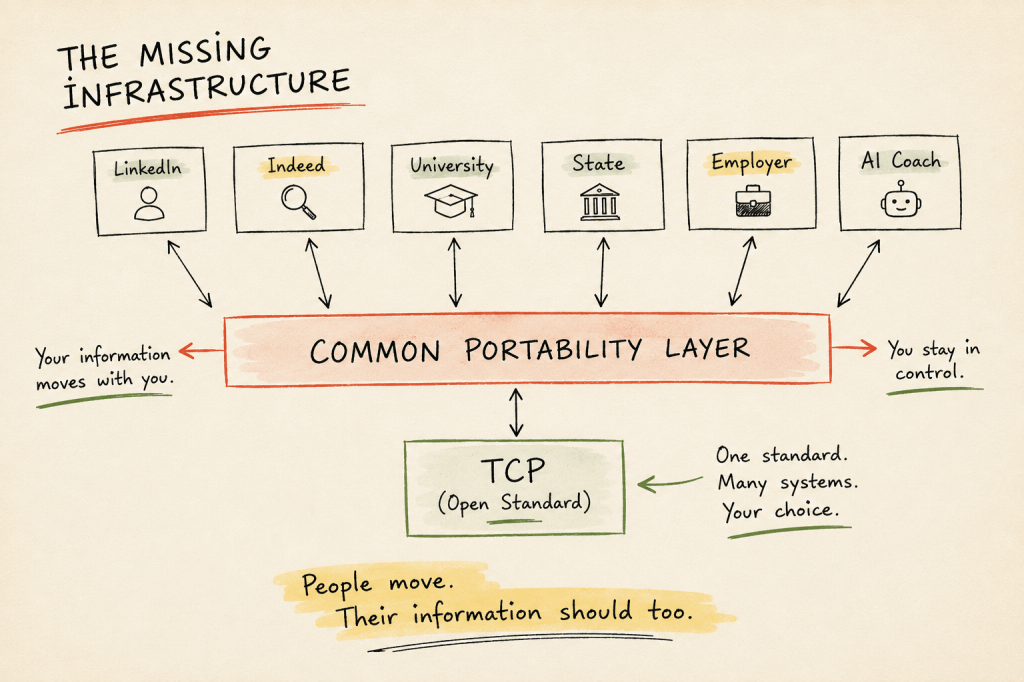
Imagine importing your work history. Connecting your verified credentials. Documenting your military service, volunteer work, licenses, certifications, languages, accomplishments, interests, and career goals. Then imagine taking that profile with you to apply to college, receive credit for prior learning, apply for jobs, help your employer understand your full capabilities, help a state workforce agency connect you to new opportunities, or give an AI career coach the context it needs to provide personalized guidance.
Right now, that investment of time has very little long-term value because it stays trapped inside the platform where you created it. People are understandably reluctant to spend thirty minutes building a rich profile when they know they’ll have to do it all over again somewhere else.
But when that investment follows them from one system to the next, the equation changes. The more places they can use it, the more valuable it becomes.
People aren’t unwilling to invest time building rich profiles. They do it every day. They’re unwilling to make the same investment over and over again. Portability changes the return on that investment because the value of the profile grows every time it can be reused.
The goal isn’t for every platform to use the same profile. The goal is for every platform to begin with the information an individual chooses to bring with them.
As people move between systems, they shouldn’t lose the time they’ve invested building richer profiles. Instead, each new platform starts with better information than the last one, adds what it learns, and allows the individual to take that expanded profile wherever they go next.
The goal isn’t to standardize where people build profiles. It’s to standardize their ability to move them.
Just as public roads make transportation possible regardless of which vehicle you drive, public infrastructure for profile portability should make it possible for people to move their workforce information regardless of which platform they choose.
But public infrastructure only works if everyone speaks the same language.
The internet has open protocols. Email has open protocols. The workforce ecosystem needs the same kind of open foundation.
That’s exactly what the Trusted Career Profile, from HR Open Standards, is designed to become.
It wasn’t created to replace resumes, wallets, or workforce applications. It was created to give all of those systems a common way to exchange career information while allowing each platform to innovate independently.
The Trusted Career Profile isn’t another workforce application. It isn’t another wallet. It isn’t even another profile. It’s an open standard for profile portability.
Just as internet protocols allow different networks to communicate, the Trusted Career Profile provides a common language that allows workforce platforms to exchange career information while giving individuals the freedom to carry it with them.
Building public infrastructure has always been one of government’s unique roles. Not because government builds the best products. But because government establishes the conditions that allow markets to work.
The timing couldn’t be better.
The U.S. government is already making significant investments in modernizing workforce infrastructure. The Department of Education is supporting the launch of Learning and Employment Record talent marketplaces through the CTO Challenge. The Department of Labor is seeking public input on the future of CareerOneStop, the federal government’s flagship career navigation platform. States are modernizing workforce systems. Identity verification requirements are becoming more sophisticated. AI is dramatically increasing both the need for better workforce information and the value of structured, portable data.
These aren’t separate initiatives.
They’re different investments in the same underlying infrastructure.
Rather than treating each investment independently, this is an opportunity to establish one simple principle:
People should be able to move their workforce information wherever opportunity takes them.
That doesn’t require the government to own anyone’s profile. It requires the government to protect everyone’s ability to move it.
CareerOneStop may be the logical place to begin.
Not because it should become everyone’s permanent destination.
But because it’s already designed to help people understand careers, education pathways, training opportunities, and employment opportunities. It’s a natural place to invite people to make the initial investment in a portable career profile that they own—not one that belongs to the government.
From there, people should be free to take that profile wherever opportunity exists.
Every receiving platform should be free to represent that information however it chooses, collect additional information, and innovate on top of it.
The only thing that becomes standardized is the individual’s ability to bring their information with them.
That’s why I believe any workforce platform built with public funding should be required to allow individuals to import and export their career profile using an open standard. Not because every platform should look the same. Because every person should have the same freedom to move.
Private companies would still compete. States would still innovate. Universities would still differentiate themselves. AI companies would still build better career guidance. Competition doesn’t disappear. It simply starts from a stronger foundation.
The workforce ecosystem doesn’t need one platform to replace every other platform. It needs people to stop recreating themselves every time they encounter one.
That’s the promise of public infrastructure. Roads allow us to choose our destination. Internet protocols allow us to choose our websites. GPS allows us to choose our navigation apps.
Workforce infrastructure should allow people to choose the platforms that work best for them—without leaving their information behind each time they move.
The goal isn’t one profile. It isn’t one platform. It isn’t one wallet. It’s protecting every person’s ability to carry the information they’ve invested in creating wherever opportunity leads them.
Because careers don’t belong to platforms.
They belong to people.
That’s the missing infrastructure.

 Signol Labs
Leave a comment