
Recently I found myself reading a grant proposal that I couldn’t put down.
It wasn’t because it introduced a revolutionary idea. In fact, much of what it described wasn’t entirely new to me. What made it so compelling was the realization that many of the ideas I’d been following for years were beginning to converge in the thinking of others. As I sat there reading another team’s vision for a workforce ecosystem, I found myself unexpectedly emotional. It felt like some of the ideas I believe in most were finally becoming a shared understanding—and that real change might actually be possible.
Upon reflection, I don’t think my career has been a series of jobs. It has been one long investigation driven by curiosity, where every answer created another question, and every question led somewhere I never expected to go.
I began my career in advertising, but quickly became more interested in why advertising worked than in the advertisements themselves. That curiosity pulled me into the early days of programmatic advertising, marketplaces, APIs, and product architecture. I became fascinated by how information moves between systems, how decisions are made, and how better data changes outcomes.
At the time, each move felt like a change in direction. But I was simply following the next question.
Years later, while working in job marketplaces, another question emerged. How do you help people who never make it onto a job board?
The obvious answer seemed to be finding people as they started thinking about changing their careers. That led me to learning platforms like Coursera and Udemy, where millions of people were investing in themselves long before they ever updated a résumé.
My assumption was that perhaps jobs should be brought into those platforms. Instead, those conversations revealed something much more interesting. The learning platforms weren’t asking for job postings. They wanted learners to be able to carry trusted evidence of what they had accomplished wherever they went.
At first I thought I was looking at a new kind of credential. Then it hit me. This wasn’t really about credentials at all. I was looking at the future of data.
Years earlier I’d watched browser cookies transform internet advertising by allowing systems to recognize people across websites. Digital credentials felt like they were trying to solve a remarkably similar problem—but with a completely different purpose. Not helping platforms understand consumers, but helping digital systems understand people.
In an instant, everything looked different. What fascinated me wasn’t the credential itself. It was the realization that people were trying to create portable, consent-based data designed for human empowerment.
That realization sent me looking for more information. It led me to an early paper from 1EdTech describing what was then called the Interoperable Learning Record. It led me to implement digital credentials at ZipRecruiter. That work introduced me to Mark Leuba, who invited me to speak at the 1EdTech Digital Credentials Summit. There I met the SmartResume team, which immersed me in the Learning and Employment Record ecosystem.
Along the way I met remarkable people like Sean Murphy and discovered a community trying to solve problems that most of the world didn’t even realize existed.
Looking back, I realized I had developed a habit. Whenever I encountered something that didn’t fit my understanding of how the world worked, I started reading. Then I started asking questions of the smartest people I could find and connecting ideas. Eventually I started drawing maps—not because I wanted to document ecosystems, but because I needed a way to organize what the signals were telling me
I wasn’t just following my interests. I was following signals. A signal is simply something that doesn’t fit your understanding of the world. It creates just enough tension that you can’t help but ask another question.
I’ve come to believe that progress begins with noticing signals that other people overlook. Those signals create questions. The questions lead to understanding. And understanding changes what becomes possible.
The seemingly unrelated chapters of my career no longer feel unrelated at all. Each one gave me just enough understanding to recognize the next signal when it appeared.
Eventually those questions converged on a realization I couldn’t ignore: education, hiring, workforce development, and public policy were all trying to solve pieces of the same problem, yet they struggled because they lacked a shared understanding of people. More than any single product, I found myself drawn to the infrastructure that allows those systems to connect.
I didn’t start Signol Labs because I wanted to start a consulting company. I started it because eventually there wasn’t anywhere else to continue the investigation.
It’s difficult not to feel like there was a thread running through all of it. None of these decisions were part of a master plan. They were simply the next interesting question.
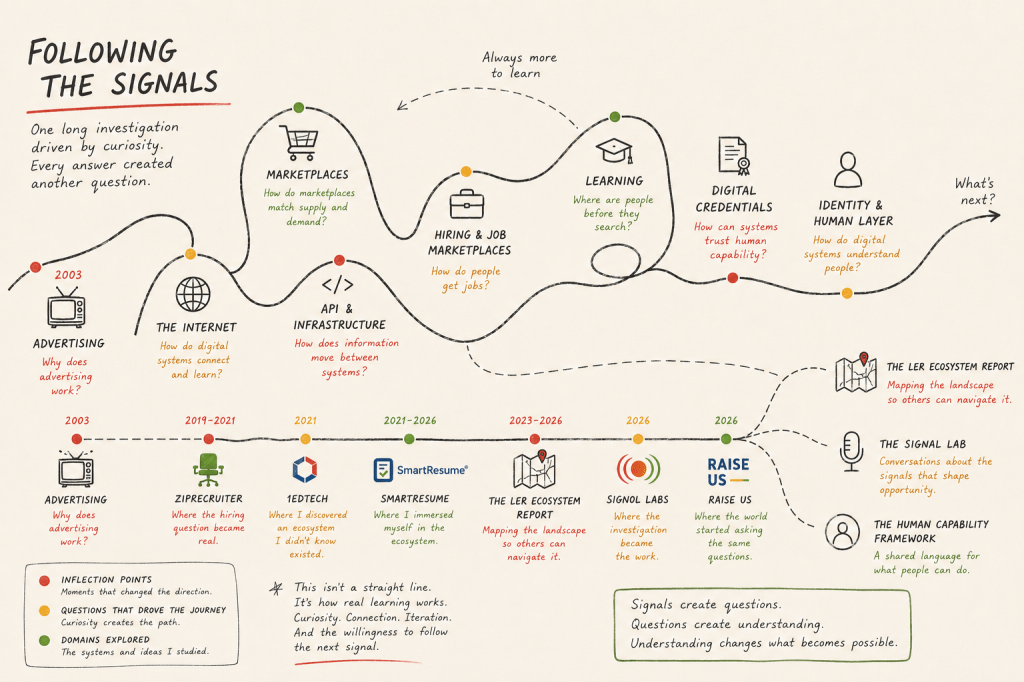
Yet somehow they all led to the same investigation.
Maybe that’s just what happens when curiosity compounds over twenty years. Maybe it’s providence. Maybe those are the same thing. I don’t know. What I do know is that eventually the next question became impossible to ignore. How do we create the infrastructure required to help digital systems understand human capability?
That question led me to start Signol Labs.
Then RAISE US found me. Not because I had been pursuing a role in workforce development, but because twenty years of following questions had quietly prepared me for new questions that have suddenly become vitally important.
How do we reimagine the systems that guide people to education, training, and careers? When career paths end, how do we understand people deeply enough to help them pivot without losing years they’ve invested in their own capabilities. How do we create infrastructure that recognizes what someone is capable of – not just where they’ve been?
Every time I thought I’d found an answer, what I actually found was a better question.
And if the last twenty years have taught me anything, it’s that they’ll probably lead to better questions.
Apparently, there are still more signals worth following.

 Signol Labs
Leave a comment