
Hiring has a data problem. But underneath it is an architecture problem.
Every day, job boards, ATSs, recruiters, hiring managers and other systems make decisions that determine who gets access to employment opportunity. Each evaluates different information, looks for different signals, and makes different decisions.
But there is no shared architecture connecting them.
The Hiring Decision Architecture is our attempt to build one.
Version 1 – A Public Working Draft
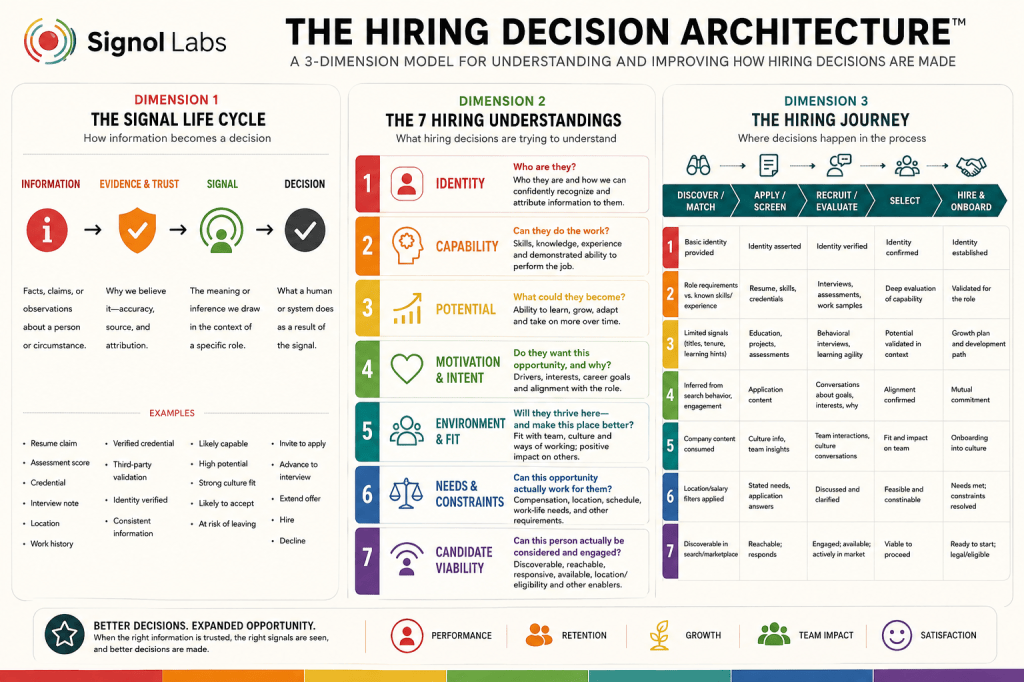
Hiring has been studied from countless perspectives: skills, assessments, credentials, matching, recruiting, selection, job design and hiring technology. What we haven’t found is a shared architecture that connects these layers—mapping what people and systems are trying to understand, how information becomes a signal, and where those signals influence decisions.
So we built a first version.
It emerged from interviews across the hiring funnel, including hiring managers, recruiters, job boards, applicant tracking systems and talent marketplaces. We’re sharing it publicly because we believe a common architecture becomes more valuable when the people who operate different parts of the system can challenge and improve it.
DIMENSION 1 — THE SIGNAL LIFE CYCLE
How information becomes a decision.
Information about a person becomes more useful when we can establish evidence and trust, interpret what it signals in context, and use that signal to inform a decision.
DIMENSION 2 — THE SEVEN HIRING UNDERSTANDINGS
What hiring is trying to understand about a person.
Identity · Capability · Potential · Motivation & Intent · Environment & Fit · Needs & Constraints · Candidate Viability
DIMENSION 3 — THE HIRING JOURNEY
Where decisions happen.
Different people and systems encounter different information, interpret different signals, and make different decisions as someone moves through hiring.
The power is in the intersection of these three dimensions.
A hiring manager may care deeply about someone’s potential. A recruiter may uncover their motivation. An ATS may never see either. A job board may have to make a matching decision before any of that information exists.
The architecture lets us see those gaps—and start designing around them.
The architecture doesn’t operate in one system.
Information about a person is created, represented, discovered, submitted, filtered, expanded and acted upon across an entire hiring ecosystem.
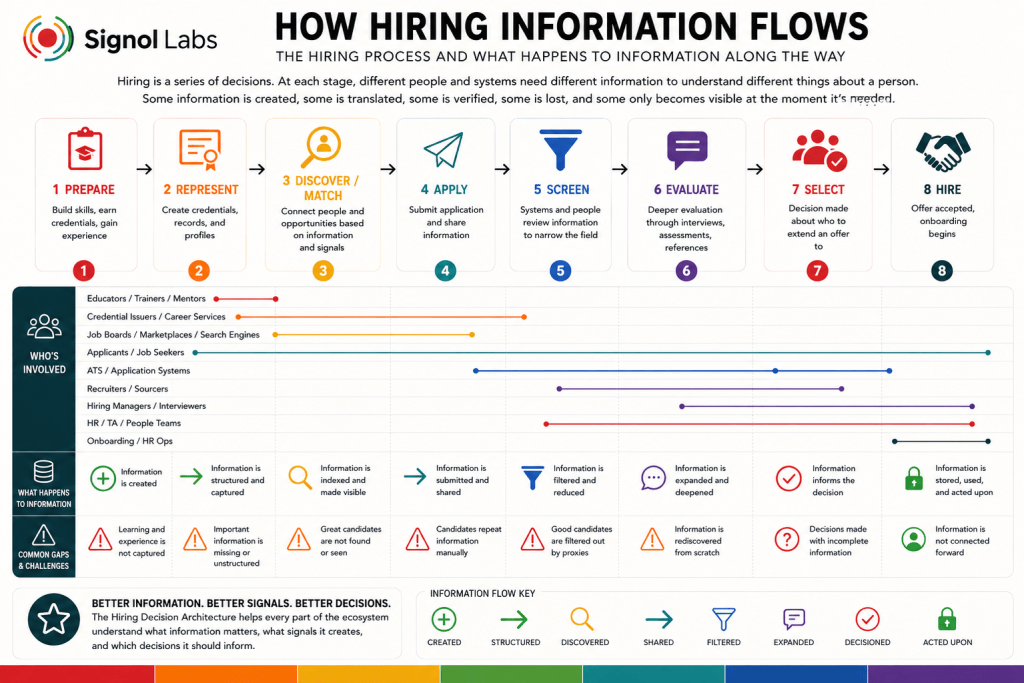
One architecture. Different applications across the ecosystem.
Role | How It Can Help |
|---|---|
| Career Preparation & Guidance | Help job seekers understand the information and evidence they need to communicate throughout hiring. |
| Digital Credentials & LERs | Design credentials that provide trusted information capable of influencing real hiring decisions. |
| Resumes & Profiles | Represent more of what employers actually want to understand about people—not just what fits on a traditional resume. |
| Talent Marketplaces & Job Boards | Improve discovery and matching by incorporating a broader set of information and signals about people and opportunities. |
| Job & Opportunity Design | Define what actually matters for success before translating those needs into requirements and job descriptions. |
| ATS & Hiring Technology | Capture better requirements, evaluate more meaningful information, and surface better signals to decision-makers. |
| Recruiting & HR | Map the hiring funnel and technology stack to identify missing information, lost signals, and opportunities for better decisions. |
Start with the decision
Most hiring systems begin with the information they already have.
The Hiring Decision Architecture starts with the decision we are trying to make.
What are we trying to understand about this person?
What information would help us understand it?
What evidence would make that information trustworthy?
What does it signal in the context of this opportunity?
Which decision should that signal inform?
Working backward from the decision changes the question from “What data can we collect?” to “What do we need to know to make a better decision?”
This is Version 1. Help us make Version 2 better
We’re actively testing the architecture with employers, recruiters, hiring technology companies, workforce organizations, credential providers and researchers.
We want to know:
- What’s missing?
- Where does this fail to describe how hiring actually works?
- What information matters to your decisions that today’s systems can’t see?
Share your feedback: connect@signollabs.comShare feedback: connect@signollabs.com
Hear how we got here.
In Search of Signals
We spent months interviewing the people and companies making decisions at different layers of hiring. We went looking for the signals that determine who gets hired.
We came away with something we weren’t expecting: an architecture for understanding how those decisions fit together.
 Signol Labs